
Tool
Steal an Egg size calculator: weight ratio to size multiplier and income
The size formula and the 100×/200×/1000× checkpoints are quoted from the Steal An Egg Wiki's Mutations page (revision of 20 September 2026, re-read 21 October 2026). Every other multiplier on this page is our arithmetic on that formula.
A Steal an Egg size calculator has to reproduce three numbers the community wiki prints: an egg at 100 times its pet's base weight earns about 17 times base income, one at 200 times earns about 23 times, and one at 1,000 times earns about 45 times. The tool below starts from those checkpoints and the formula behind them. Our own arithmetic gives 17.11, 23.70 and 45.12, so the wiki's "~23" is rounded down slightly. The other two match.
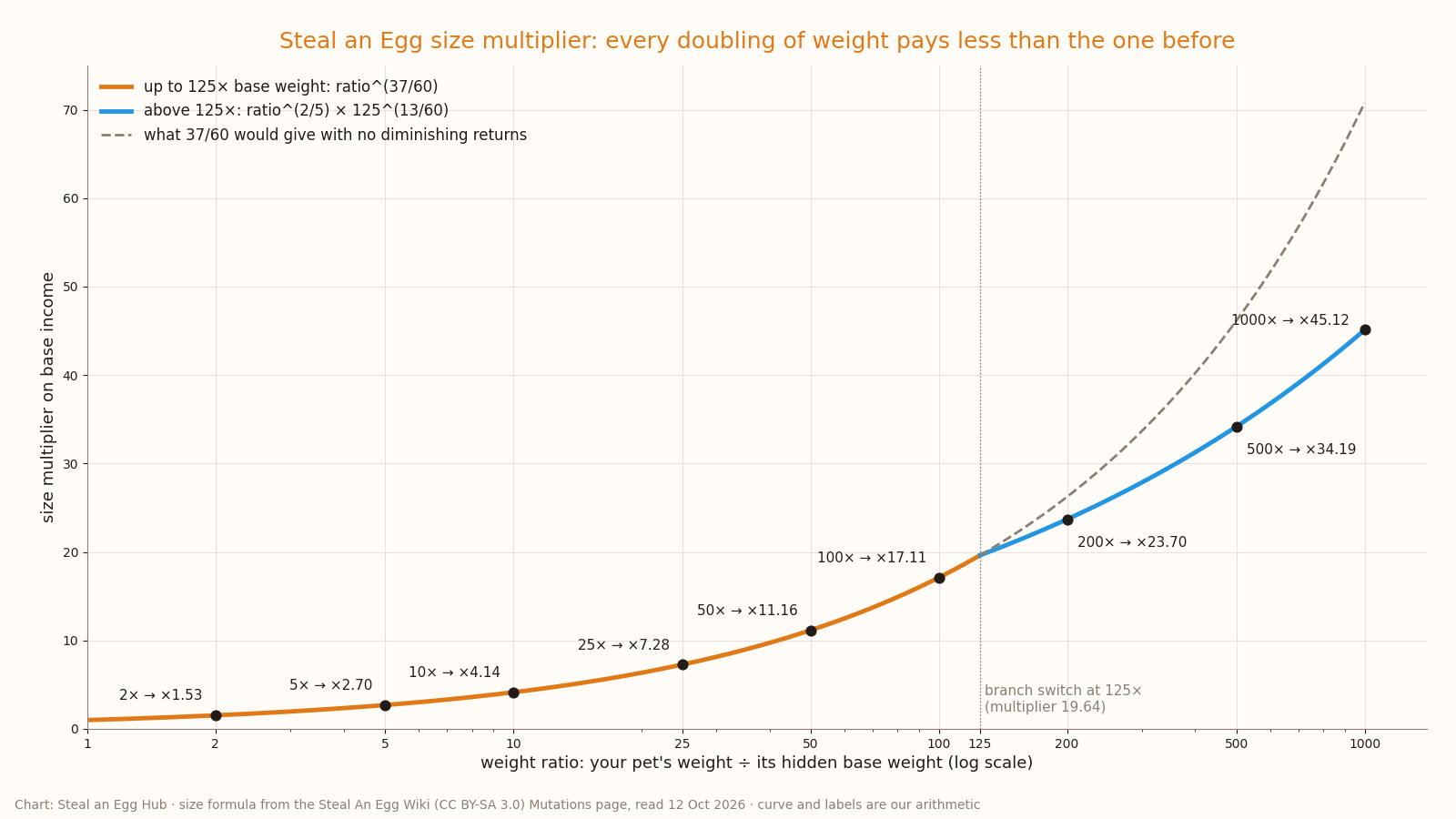
Those figures come from a two-part rule. Up to 125 times base weight the size multiplier is the weight ratio raised to the power 37/60. Above 125 times, the game applies diminishing returns: the ratio to the power 2/5, multiplied by 125 to the power 13/60. The two parts meet exactly at 125×, where the multiplier is 19.64. Going from 125× to 1,000× base weight is eight times the kilograms, yet the multiplier only rises from 19.64 to 45.12.
The catch is the input. The wiki says every pet has a hidden base weight, and nobody publishes it. Your card shows kilograms, not a ratio. So the calculator takes either a ratio you already know, or two weights where a normal-size card of the same pet stands in for the base weight. Pick one of the 265 pets and a mutation, and it multiplies everything into income per second.
Size multiplier
×17.11
Ratio 100× → ratio^(37/60) (up to 125×).
At this size: $257M/s
≈ 41.8× the base weight
| Ratio | 1× | 2× | 5× | 10× | 25× | 50× | 100× | 125× | 200× | 500× | 1000× |
|---|---|---|---|---|---|---|---|---|---|---|---|
| Size | ×1.00 | ×1.53 | ×2.70 | ×4.14 | ×7.28 | ×11.16 | ×17.1 | ×19.6 | ×23.7 | ×34.2 | ×45.1 |
What each box in the calculator does
The tool has two ways in, one optional add-on and one reverse box. Nothing in it reads from the game. It applies the wiki's published formula to numbers you type.
- Input A, the weight ratio: type your pet's weight divided by its base weight, for example 100. This is the exact input the wiki formula expects. Use it when you already know the ratio.
- Input B, two weights in kg: type your pet's kilograms and the kilograms shown on a normal-size card of the same pet. The tool divides the first by the second and uses that as the ratio. This is an approximation. The wiki says base weights are hidden, so a normal-looking card is a stand-in, not the real base weight.
- The result: the size multiplier to two decimals, plus which branch of the formula applied. Ratios up to 125 use ratio^(37/60). Ratios above 125 use ratio^(2/5) × 125^(13/60).
- Optional pet and mutation: choose any of the 265 pets (base income from the wiki infoboxes and its pet data module) and a mutation, from Silver ×1.2 to Rainbow ×3.5. The tool then shows base income × mutation multiplier × size multiplier as money per second, which is the wiki's final income formula.
- Reverse box: type a target multiplier, say ×20, and it returns the weight ratio needed to reach it (130.84 for ×20).
11 checkpoints, computed from the formula
These are fixed values, so they can be printed once and checked against the tool. We computed each one from the wiki's formula and rounded to two decimals. The 100×, 200× and 1,000× rows are the three the wiki quotes itself.
Two patterns stand out. Doubling the ratio below 125× multiplies income by 2^(37/60), about 1.53. Doubling it above 125× multiplies income by 2^(2/5), about 1.32. That gap is the diminishing return the wiki describes: bigger eggs keep earning more, but each extra kilogram adds less.
One wiki page disagrees slightly with the formula. The Aetheron pet page (read 21 October 2026) lists its own size table: ×7.29 at 25, ×11.18 at 50, ×14.37 at 75, ×17.18 at 100 and ×19.74 at 125, a little above the 7.28, 11.16, 14.33, 17.11 and 19.64 the Mutations formula gives (its 1, 2, 5 and 10 rows match ours). The wiki does not explain the gap, so the calculator follows the Mutations page's formula and we show both.
| Weight ratio (actual ÷ base) | Size multiplier | Branch |
|---|---|---|
| 1× | ×1.00 | 37/60 power |
| 2× | ×1.53 | 37/60 power |
| 5× | ×2.70 | 37/60 power |
| 10× | ×4.14 | 37/60 power |
| 25× | ×7.28 | 37/60 power |
| 50× | ×11.16 | 37/60 power |
| 100× | ×17.11 (wiki: ~17) | 37/60 power |
| 125× | ×19.64 | both branches meet |
| 200× | ×23.70 (wiki: ~23) | diminishing returns |
| 500× | ×34.19 | diminishing returns |
| 1000× | ×45.12 (wiki: ~45) | diminishing returns |
Why does the curve bend at 125×?
Because the wiki says that is where the game switches formulas. Below the line, income grows with the ratio to the power 37/60, about 0.617. Above it, the exponent drops to 2/5, or 0.4, and the extra factor 125^(13/60) keeps the two pieces joined. At exactly 125× both give 19.64, so there is no jump or cliff in the curve.
The chart shows the real curve in orange and blue. The dashed grey line is what the 37/60 rule would have paid had it carried on past 125×. At 1,000× the gap is large: 45.12 on the real curve against about 70.8 on the dashed one. That missing 25 or so is the size of the diminishing return at the top end.
For a player, the practical reading is simple. Up to 125×, a heavier egg is a strong upgrade. Past it, a heavier egg is still an upgrade, but it takes eight times the weight ratio to move the multiplier from about 20 to about 45.
The kilogram problem
The weight on your pet card is an absolute number in kg. The formula needs a ratio. The missing piece is the base weight, and the wiki is explicit that it is hidden: "each pet has a hidden base weight that correlates with their base income." It does not list a single one. Neither does any other source in our register.
That is why Input B exists and why it is labelled an approximation. If you divide by the weight of a normal-size card of the same pet, you get a usable estimate. It carries some assumptions you should know about:
- The normal-size card you compare against sits close to the true base weight. The wiki does not say what weight a "normal" roll lands on, so the stand-in may be off.
- You compare the same pet. Base weight correlates with base income, per the wiki, so a Kraken's kilograms and a Chicken's kilograms are not on the same scale.
- Small errors in the stand-in shrink in the result. Because the exponent is below 1, a 10 % error in the ratio moves the multiplier by about 6 % below 125×, and by about 4 % above it (our arithmetic: 1.1^0.617 and 1.1^0.4).
- The tool never invents a base weight for you. If you leave the second weight blank, Input B returns nothing.
From multiplier to money per second
The wiki's final rule is base income × mutation multiplier(s) × size multiplier. The size multiplier is the only part this page adds; base income comes from the pet's infobox and the mutation multiplier from the Mutations page. Four worked cases on the Kraken, a Secret pet from the Abyss Ocean listed at $15M/s:
- No mutation, 10× base weight: $15M × 4.14 ≈ $62.1M/s.
- No mutation, 100× base weight: $15M × 17.11 ≈ $256.7M/s.
- Rainbow (×3.5), 100× base weight: $15M × 3.5 × 17.11 ≈ $898M/s.
- Golden (×2.5), 1,000× base weight: $15M × 2.5 × 45.12 ≈ $1.69B/s.
Final Income = Base Income × Mutation(s) Multiplier × Size Multiplier
— Steal An Egg Wiki, Mutations page
Running it backwards: what ratio gives ×N?
The reverse box inverts the formula. Below a multiplier of 19.64 it takes the target to the power 60/37. Above 19.64 it divides the target by 125^(13/60) and raises the result to the power 5/2. Some targets people ask about, all our arithmetic:
- ×2 needs a ratio of about 3.08.
- ×3 (the Giant figure in the wiki's example) needs about 5.94.
- ×5 (the Huge figure in the wiki's example) needs about 13.60.
- ×10 needs about 41.84.
- ×20 needs about 130.84, just past the 125× switch.
- ×30 needs about 360.56.
- ×45 needs about 993.59, which is why the wiki rounds 1,000× to ~45.
- ×50 needs about 1,293.
- ×100 needs about 7,314. Every extra unit of multiplier above ×20 costs far more weight than the one before.
Heavier eggs pay more, and slow you down
Size is not free. The wiki's Eggs page says eggs of various sizes appear in each area, that "the larger the egg, the higher the value multiplier applied to the animal inside it", and then: "But above all, it will be heavier, and you will be slower." The page also notes that egg colour does not change income, so the advice there is to read the egg's shape.
The wiki does not put a number on the slowdown. It does not say how many kg cost how much speed, so this calculator does not model it. What it can tell you is the payoff side of the trade: how much extra income a heavier egg would bring. Whether you can carry it past the guardian is a speed question, covered on our speed guide, where Treadmills and Trails are the upgrades the wiki names.
Size is also rolled separately from colour. The wiki puts it plainly: the same pet can appear as a Golden Giant or as a plain Huge with no colour mutation. The calculator treats them as two independent multipliers for that reason.
Questions people ask
- Is there an egg size calculator for Steal an Egg?
- Yes, this page. It converts a weight ratio into the size multiplier with the wiki's formula, and can add a pet and a mutation to give income per second. It does not read the game; you type the numbers.
- What is the size multiplier formula?
- From the wiki's Mutations page: up to 125× base weight, multiplier = (actual weight ÷ base weight)^(37/60). Above 125×, multiplier = (actual ÷ base)^(2/5) × 125^(13/60). Final income is base income × mutation multiplier × size multiplier.
- How much does a 100× egg make?
- About 17.11 times base income, before any mutation. The wiki rounds it to ~17. At 200× it is 23.70 and at 1,000× it is 45.12.
- If I have a 1,311,320 kg Kraken egg, how much would it make?
- The kilograms alone cannot answer it, because the formula needs the ratio to the Kraken's hidden base weight and the wiki does not publish it. On the Kraken's listed $15M/s with no mutation, a 100× ratio gives about $257M/s, 1,000× about $677M/s and 10,000× about $1.70B/s. Divide your kg by a normal Kraken card's kg to estimate which of those you are near.
- How many kg is base weight for each pet?
- Unknown. The wiki says each pet has a hidden base weight that correlates with its base income, and it lists none. No source in our register publishes them.
- How big is a Giant or a Huge?
- The wiki does not say in kilograms. Its worked examples treat Giant as ×3 and Huge as ×5. By the formula those multipliers correspond to ratios of about 5.94 and 13.60, but that is our arithmetic, not a published size band.
- Can I use the calculator with only my pet's weight?
- Not on its own. Input B needs a second weight, a normal-size card of the same pet, to stand in for the base weight. Without it there is no ratio to work from.
- Why does a bigger egg earn less per kg?
- Diminishing returns. The exponent is 37/60 below 125× and 2/5 above it, so doubling the ratio multiplies income by about 1.53 low down and only about 1.32 past 125×.
- Which mutations can I pick in the calculator?
- Nine options, from the wiki's Mutations page: None ×1, Silver ×1.2, Bloom ×1.25, Golden ×2.5, Spirit Bloom ×2.5, Fractured ×2.75, Scrambled ×2.75, Parasite ×3 and Rainbow ×3.5. The calculator multiplies the one you pick into the size result.
- Does a bigger egg make me slower?
- Yes, according to the wiki's Eggs page: larger eggs are heavier and you will be slower. The wiki gives no figure for how much, so the calculator does not include it.
- Does egg colour affect size or income?
- No. The Eggs page says egg colours change appearance only, not income. Colour mutations on the hatched pet, like Golden or Rainbow, are a separate thing and do multiply income.
- Is the size roll random?
- The wiki says size is rolled separately from colour at hatch time. It does not publish the odds of any size, so we do not quote any.
- Does the calculator include the 2x Money game pass?
- No. It follows the wiki's income formula only. If you own a pass that doubles money, multiply the result yourself.
Sources & further reading
- Steal an Egg on Roblox, official game page, read 2026-10-21
- Steal An Egg Wiki — Mutations, rev 1822, read 2026-10-21
- Steal An Egg Wiki — Eggs, rev 2150, read 2026-10-21
- Steal An Egg Wiki — Kraken, rev 1073, read 2026-10-21
- Steal An Egg Wiki — Aetheron, rev 2431, read 2026-10-21
- Steal An Egg Wiki — Pets, rev 1774, read 2026-10-21
- Steal An Egg Wiki (Fandom, CC BY-SA 3.0) — Module:Pets/Data, rev 2636, read 2026-10-25
Read next
- Steal an Egg mutations and sizes
Steal an Egg mutations explained: Rainbow ×3.5 (1/100), Golden ×2.5 (4/100), Silver ×1.2 (6/100), Parasite, Fractured, Spirit Bloom, Bloom, plus size maths.
- Steal an Egg calculator
Steal an Egg calculator: pick any of the 265 pets, a mutation (Silver ×1.2 to Rainbow ×3.5) and a size, and get income per second from the wiki's formula.
- Steal an Egg mutation calculator
Steal an Egg mutation calculator: pick a pet or type its income and see all eight mutations side by side, from Silver ×1.2 and Scrambled ×2.75 to Rainbow ×3.5.
- Steal an Egg value calculator
Steal an Egg value calculator: pick one of 265 pets, add mutation, size and the 2x Money pass, and see income per second, overnight, per day and time to a goal.
- Steal an Egg speed
Steal an Egg speed explained: hatch rewards, the 10,000-speed gift, treadmills, trails and Robux multipliers, plus all eleven zone gates from 900 to 20B.
Part of Steal an Egg guides. Back to the Steal an Egg Hub home page.

Sukie · Editor
Sukie is the editor of Steal an Egg Hub and writes and edits its guides, pet tables and calculators. The work centres on turning the game's published numbers into plain answers players can check: every page names its sources and the date they were read, and anything the sources do not state is left out rather than guessed. Corrections sent through the contact page are read and acted on.
Everything Sukie has written · About this site · How pages are checked · Last updated October 25, 2026
Steal an Egg Hub is an unofficial fan site. It is not affiliated with, endorsed by or associated with the 'and Collect Rare Pets' group or Roblox Corporation. Game names, images and trademarks belong to their owners.