
Guide
Steal an Egg values: what actually makes a pet worth more (and why there is no value list here)
Steal an Egg values is a search that assumes two things: that pets can be traded, and that someone keeps a list of what they trade for. As of 13 September 2026 neither is documented anywhere in our register. The official description does not mention trading; the community wiki has no trading or values page; and the numbers on value sites for this game are, as far as we can tell, invented. So this page does something different. It sets out what would make one pet worth more than another — because the game publishes those numbers — and shows you how to compare any two pets with them. If a trading system or a sourced value list ever appears, this page will change.
First, the honest part
There are four things this page will not do. It will not publish a value list, because no source measures one. It will not describe how trading works, because nothing in the register documents a trading system. It will not rank pets by demand, because demand is not observable from outside the game. And it will not use the word 'community-tracked' as if it were a source.
What it will do is use the numbers that are published — base income, mutation multipliers, the size formula, grow time, zone gates, and which pets are obtainable at all — to explain worth in the only terms that can be checked.
Factor one: base income, which is rarity in numbers
Every pet has a listed base income, and it tracks rarity almost perfectly: Commons earn $1–6/s, Legendaries $1.8K–130K/s, Secrets $1.25M–215M/s, Eternals $65M–900M/s, Divines $1B–3.5B/s. Base income is the floor of a pet's worth because it is what the pet does every second regardless of anything else. Two pets of the same rarity can differ by a hundredfold, though: the Legendary Brr Brr Patapim earns $1.8K/s and the Legendary Crustacia $130K/s, so 'it is a Legendary' tells you far less than the number does.
Factor two: the mutation multiplier
The wiki's Mutations page gives seven multipliers: Rainbow ×3.5, Parasite ×3, Fractured ×2.75, Golden ×2.5, Spirit Bloom ×2.5, Bloom ×1.25, Silver ×1.2. Three are natural hatch rolls with published weights — Rainbow 1 in 100, Golden 4, Silver 6 — and four come only from events or consumables. A mutation multiplies base income, so its worth is proportional to the base it lands on: a Rainbow on a Chicken adds $2.50/s, a Rainbow on a Mutant Shark adds $537.5M/s.
Scarcity matters separately from the multiplier. Parasite (×3, only from the Parasite Egg in the feeding event) and Spirit Bloom (×2.5, Sakura Incubator) are event-gated; once their event ends, no new ones enter the game. That is a reason a Spirit Bloom pet might be worth more to a collector than a Golden of the same base, even though the multiplier is identical.
Factor three: size
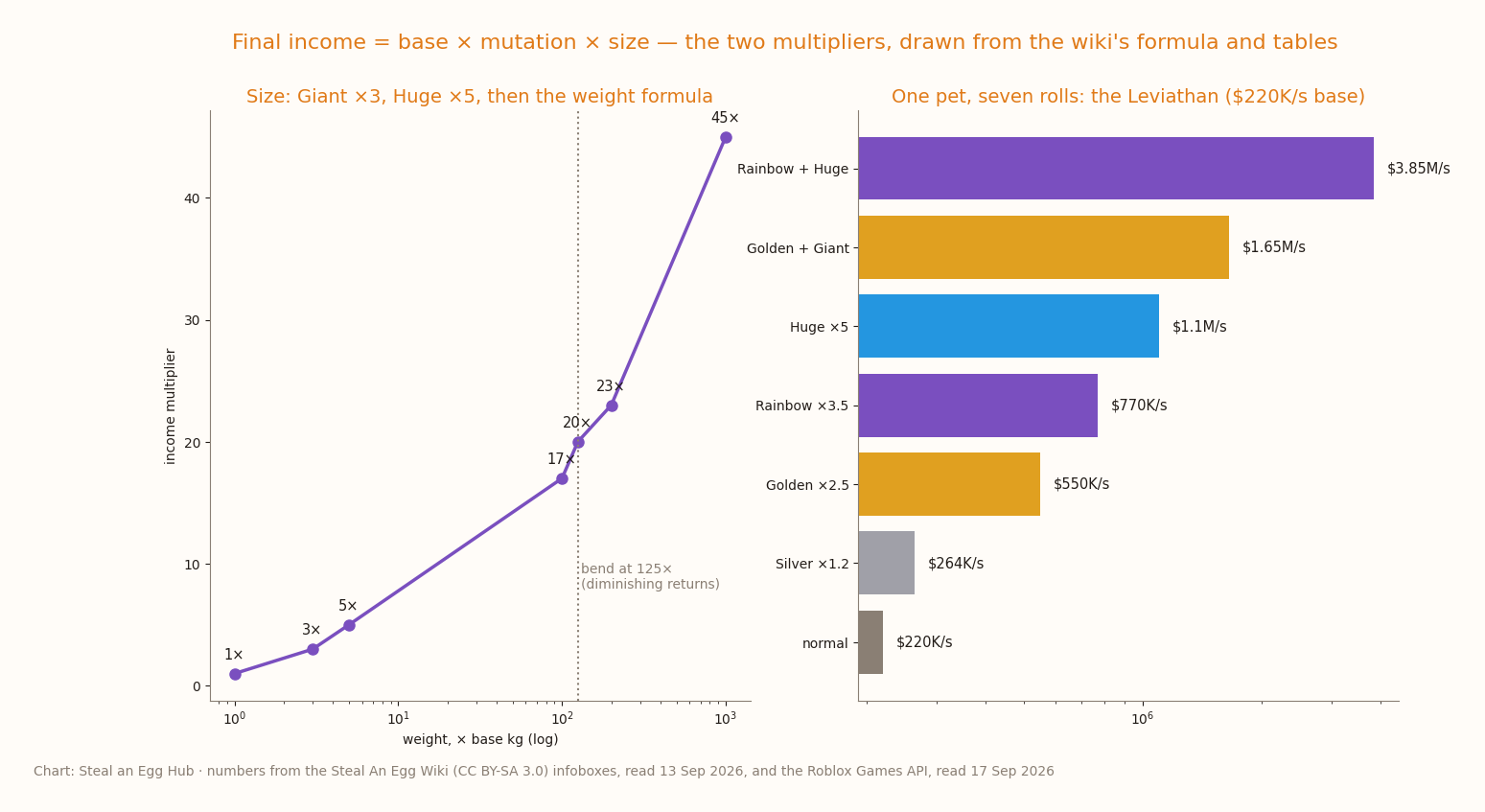
Size is the multiplier most players under-weigh. It is rolled independently of colour, shown as kilograms on the pet card, and the wiki says it has a major effect on final income because size rolls are easier to get than rare colours. Up to 125 times the pet's hidden base weight, income scales with the weight ratio to the power of 37/60; beyond that, diminishing returns. The wiki's own examples: 100× base weight ≈ 17× income, 200× ≈ 23×, 1,000× ≈ 45×. Its combination examples set Giant at ×3 and Huge at ×5.
So a Huge, un-mutated pet (×5) is worth more than a Golden, normal-size one (×2.5), and a Rainbow Huge (×17.5) is worth more than the next rarity tier's plain pet in most zones. When comparing two pets, look at the kilograms before the colour.
Factor four: time in the pen
Grow time is a cost. A Nightflame is 16 hours of exposure to six other players; a Rhinotaur in the same zone is 29 minutes for $17.5M/s. An already-hatched pet has paid that cost; an egg has not. If anything in the game were tradeable, a hatched Eternal would be worth more than an Eternal egg for that reason alone, and the difference would be larger on busy servers.
| Factor | Range | Source |
|---|---|---|
| Base income | $1/s (Chicken) to $4B/s (Mecha Dreadscale) | Wiki pet infoboxes |
| Mutation multiplier | ×1.2 (Silver) to ×3.5 (Rainbow) | Wiki Mutations page |
| Size multiplier | ×3 Giant, ×5 Huge; formula up to ≈45× at 1,000× base weight | Wiki Mutations and Pets pages |
| Grow time | 10 seconds (Chicken) to 16 hours (Nightflame) | Wiki pet infoboxes |
Factor five: whether it can still be obtained
Twenty-three pets are event-only and, per the Eggs page, never spawn in nests; when their event is over there is no new supply. Seventeen are Rift pets available only while the Rift event runs. The rest are zone pets that respawn on a five-minute cycle behind a speed gate. Whatever a pet's numbers, a pet nobody can obtain any more is worth more to the people who want it than one anyone can farm this afternoon — and a pet behind a 7B speed gate is worth more than its income implies simply because 0.8 % of players have reached the tier (Roblox badge statistics, 13 September 2026).
How to compare two pets in practice
Multiply base income by the mutation multiplier by the size multiplier for each — the calculator page does it — and you have the income comparison. Then ask three yes-or-no questions: is it already hatched; is it still obtainable; is it behind a gate the other player cannot reach. Each yes is worth more than the number suggests. That is as far as sourced reasoning goes. Anything past it is opinion, and this site labels opinion as opinion.
- Income: base × mutation × size (calculator).
- Hatched or egg? Hatched has paid its grow time.
- Obtainable today? Event and Rift pets may not be.
- Gate: which zone, and can the other person reach it?
- Scarcity of the mutation: Parasite and Spirit Bloom are event-gated.
Why other sites' value lists disagree with each other
Because none of them is measuring anything. A value list needs a market — a trading system with visible offers — and Steal an Egg does not document one. Lists that exist are copied from other games' formats and filled in by guesswork, which is why the same pet can be 'worth' three different amounts on three sites on the same day. When the sites disagree and the source is silent, the source is right.
Worked comparison: two Leviathans
Take two Lake Leviathans, base $220K/s. One rolled Golden at normal size: 220K × 2.5 × 1 = $550K/s. The other rolled no colour but Huge: 220K × 1 × 5 = $1.1M/s. The plain-looking one earns twice as much. Add a Golden roll to the Huge one and it is $2.75M/s — more than a normal Bronto, the Cosmic of a zone three gates away. If value meant anything tradeable, the kilograms on the card would matter more than the colour, and the colour more than the name.
| Roll | Income |
|---|---|
| Normal, normal size | $220K/s |
| Golden, normal size | $550K/s |
| Normal, Huge (×5) | $1.1M/s |
| Golden, Giant (×3) | $1.65M/s |
| Golden, Huge | $2.75M/s |
| Rainbow, Huge | $3.85M/s |
The 23 event pets, since scarcity is a value factor
Event pets never spawn in nests, so their supply is fixed once their event ends. By base income: Mecha Dreadscale $4B/s, Dreadscale $2B/s, Mecha Krakenoid $1B/s, Mecha Crocodon $680M/s, Ember Dragon $600M/s, Krakenoid $500M/s, Mecha Crawler $320M/s, Mecha Froggo $155M/s, Strawberry Elephant $110M/s, Drilla $100M/s, Mecha Scorpio $45M/s, Scorched Dragon $35M/s, Crocodon $30M/s, Shadow Dragon $25M/s, Bomboclat Crocolat $20M/s, Baby Aurora Dragon $5M/s, Crawler $1.5M/s, Mangolini Parrochini $800K/s, Froggo $50K/s, Belula Beluga $40K/s, Scorpio $10K/s, Bananita Dolphinita $400/s, Tung Tung Sahur $100/s. The wiki does not date the events; the updates page tracks what it does record.
Rarity tiers as income bands
Since income is the first factor, here is what each rarity label actually spans in the database, so 'it is a Mythic' can be translated into a number range.
| Rarity | Pets | Lowest | Highest |
|---|---|---|---|
| Common | 5 | Chicken $1/s | Jerboa $6/s |
| Uncommon | 3 | Bird $8/s | Fennec $18/s |
| Rare | 11 | Burrowing Owl $35/s | Dodo $280/s |
| Epic | 12 | Fox $180/s | Crane $4K/s |
| Legendary | 16 | Brr Brr Patapim $1.8K/s | Crustacia $130K/s |
| Mythic | 15 | Sand Spider $16K/s | Red Panda / Shardling $450K/s |
| Cosmic | 17 | Bladehide ($M/s as listed) | Rhinotaur $17.5M/s |
| Secret | 15 | Abyss Overlord $1.25M/s | Mutant Shark $215M/s |
| Eternal | 13 | Ice Dragon $65M/s | Void Serpent $900M/s |
| Divine | 4 | Unicorn $1B/s | Shattered Colossus $3.5B/s |
A last word on 'value'
Every number on this page is a fact about income, time or availability, and every one of them is checkable against the wiki and the Roblox page. None of them is a price. If the game adds trading and a market forms, prices will exist and will be observable in the game — and then this page will report what is observed, with the date, the same way it reports incomes now. Until then the honest answer to 'what is my pet worth' is the calculator's number, the pet's grow time, and whether anyone else can still get one.
Questions people ask
- Is there a Steal an Egg value list?
- Not a sourced one. No trading system is documented and no source measures values, so this site does not publish a list.
- Can you trade in Steal an Egg?
- Nothing in the official description or the wiki documents trading as of 13 September 2026. Treat trade offers as unverified.
- What makes a pet valuable?
- Base income, mutation multiplier, size multiplier, whether it is hatched, and whether it is still obtainable. All but the last two are published numbers.
- Is a Golden pet worth more than a Huge one?
- Golden is ×2.5 and Huge is ×5 by the wiki's examples, so a Huge un-mutated pet out-earns a Golden normal-size one of the same species.
- What is the most valuable pet?
- By income, Mecha Dreadscale ($4B/s, event) or Shattered Colossus ($3.5B/s, Rift). Both are also scarce, which would matter if trading existed.
- Why do value sites give different numbers?
- Because there is no market to measure. The numbers are guesses in a borrowed format.
- Is a Huge pet worth more than a Golden one?
- On income, yes: Huge is ×5 and Golden ×2.5 by the wiki's examples. A Golden Huge stacks both (×12.5).
- Does grow time affect value?
- As a cost, yes: a hatched pet has paid its wait; an egg has not. On a busy server the wait is exposure to theft.
Sources & further reading
- Steal an Egg on Roblox — official description (no trading system listed)
- Steal An Egg Wiki (Fandom, CC BY-SA 3.0) — Mutations (multipliers, size formula), read 2026-09-13
- Steal An Egg Wiki — pet infoboxes (income, grow time), read 2026-09-13
- Steal An Egg Wiki — Eggs (limited eggs), read 2026-09-13
- Roblox Badges API — Hatched Divine! 0.8 %, read 2026-09-13
Read next
- Steal an Egg mutations and sizes
Steal an Egg mutations explained: Rainbow ×3.5 (1/100), Golden ×2.5 (4/100), Silver ×1.2 (6/100), Parasite, Fractured, Spirit Bloom, Bloom, plus size maths.
- Steal an Egg best pets
Steal an Egg best pets from wiki infobox data (read 13 Sep 2026): the top egg in each zone, the best pet per rarity, the biggest hatch rewards for speed.
- Steal an Egg secret pets
Steal an Egg secret pets: the full Secret, Eternal and Divine lists with zone, income and grow time, plus Roblox badge statistics on how few players hatch them.
- All Steal an Egg pets
Steal an Egg pets list: every pet's base income per second, rarity, zone, egg, hatch reward and grow time from the community wiki, read 13 September 2026.
Part of Steal an Egg guides. Back to the Steal an Egg Hub home page.

Sukie · Editor
Sukie runs Steal an Egg Hub. Every pet, egg, zone and mutation on the site is checked against the Steal An Egg Wiki's infoboxes and the official Roblox game data before it is published, with the date it was read; anything the sources do not state is marked as not published rather than guessed.
About this site · How pages are checked · Last updated September 12, 2026
Steal an Egg Hub is an unofficial fan site. It is not affiliated with, endorsed by or associated with the 'and Collect Rare Pets' group or Roblox Corporation. Game names, images and trademarks belong to their owners.